



When it comes to successfully implementing AI solutions, a common refrain in most implementations is that your results are only as good as your inputs. To avoid this pitfall, we have seen both data and content teams ask “are my inputs accurate?” and stop there, completely bypassing the arguably more important question of “am I giving AI enough context to understand the meaning of my inputs?” If the answer to the latter question is no, while the AI solution may yield a response, it won’t be the best, and will ultimately necessitate rework. What does it mean to have comprehensive inputs? This piece helps connect theory to practice and get teams started on leveling up their AI implementations.
Knowledge assets are the foundation of successful AI solutions. Let’s take a step back and understand what that means. Our colleagues introduce knowledge assets as a way to expand beyond data and content and rewire the way our minds think about the wealth of information available within any given organization. To aid in this mental leap, EK highlights the types of knowledge assets commonly found in organizations by succinctly saying, “if you can tag it and connect it, it’s a knowledge asset.”
In their article on preparing assets for AI, our colleagues break down the steps needed to get started and simultaneously break the cycle of exclusively using data and content as AI inputs. Identifying knowledge assets is a crucial initial step. The next critical step is structure and modeling. Without that, knowledge assets are just isolated assets. Adding descriptive metadata is one way to provide this much-needed context. By using a real-world example, the infographic below breaks down how to develop a foundational business metadata model that effectively describes knowledge assets.
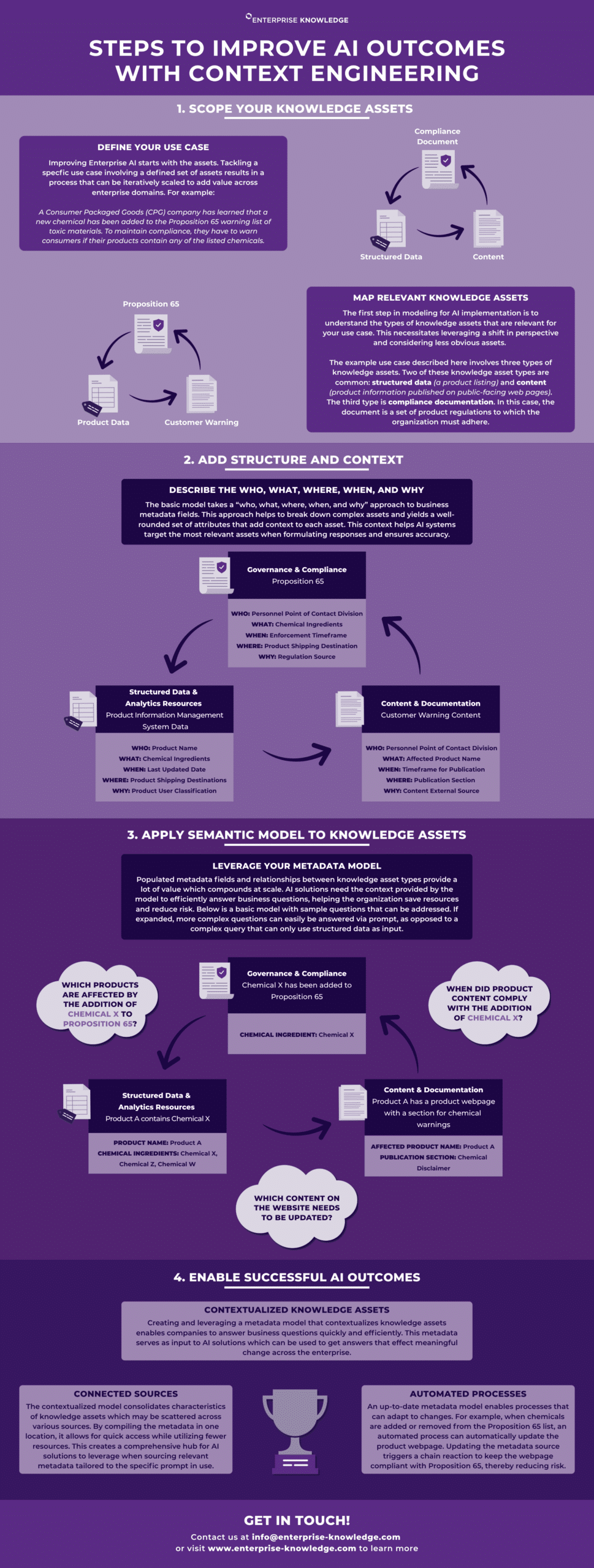
The value of connecting and standardizing these three types of knowledge assets through semantic models such as business metadata is that it breaks down the physical barriers between them. This allows the AI solution to understand all those relevant details as we humans do in order to arrive at the best, most relevant answers. If you are looking to get ahead on your AI implementations and take your prompts and results to the next level, our team of experts is ready to work with you. Contact us today to get started!