


AI solutions need to be grounded in an organization’s context. It is difficult to reliably distill context from the entirety of an organization’s knowledge assets, including facts, documents, datasets, and other structured records. Without a specific directive on what matters to the organization and how the organization operates, AI solutions are likely to misinterpret important concepts or terminology in the organization, or misuse knowledge assets as appropriate or applicable inputs. Semantic models, specifically taxonomies and ontologies, can do the heavy-lifting of distilling organizational context into formal, harmonized, and actionable structures for grounding AI solutions.
Leveraging semantic models for the right purpose is as important as using one at all. Taxonomies and ontologies have their respective strengths for conveying organizational context in AI solutions: taxonomies provide a record of operational concepts and terminology, while ontologies provide a mechanism for extending or constraining what context is referenced.
How Taxonomies Enable AI-Readiness
Taxonomies codify organizational concepts and terminology, providing AI solutions with context for what terms mean and when they are applicable. More specifically, taxonomies identify and organize terms into facets, categories, and hierarchies that reflect the meaning and role of the terms. Mature taxonomies also include definitions and alternative terms (like synonyms, initialisms, and legacy terms) to better reflect how the terms are used. Additionally, taxonomy terms may be assigned to knowledge assets as metadata to identify what the knowledge assets are, what they are about, and when they are applicable for use. These elements of taxonomies can be used in AI solutions to broaden or narrow context based on hierarchical relationships, alternative terminology and definitions, or applicable knowledge assets.
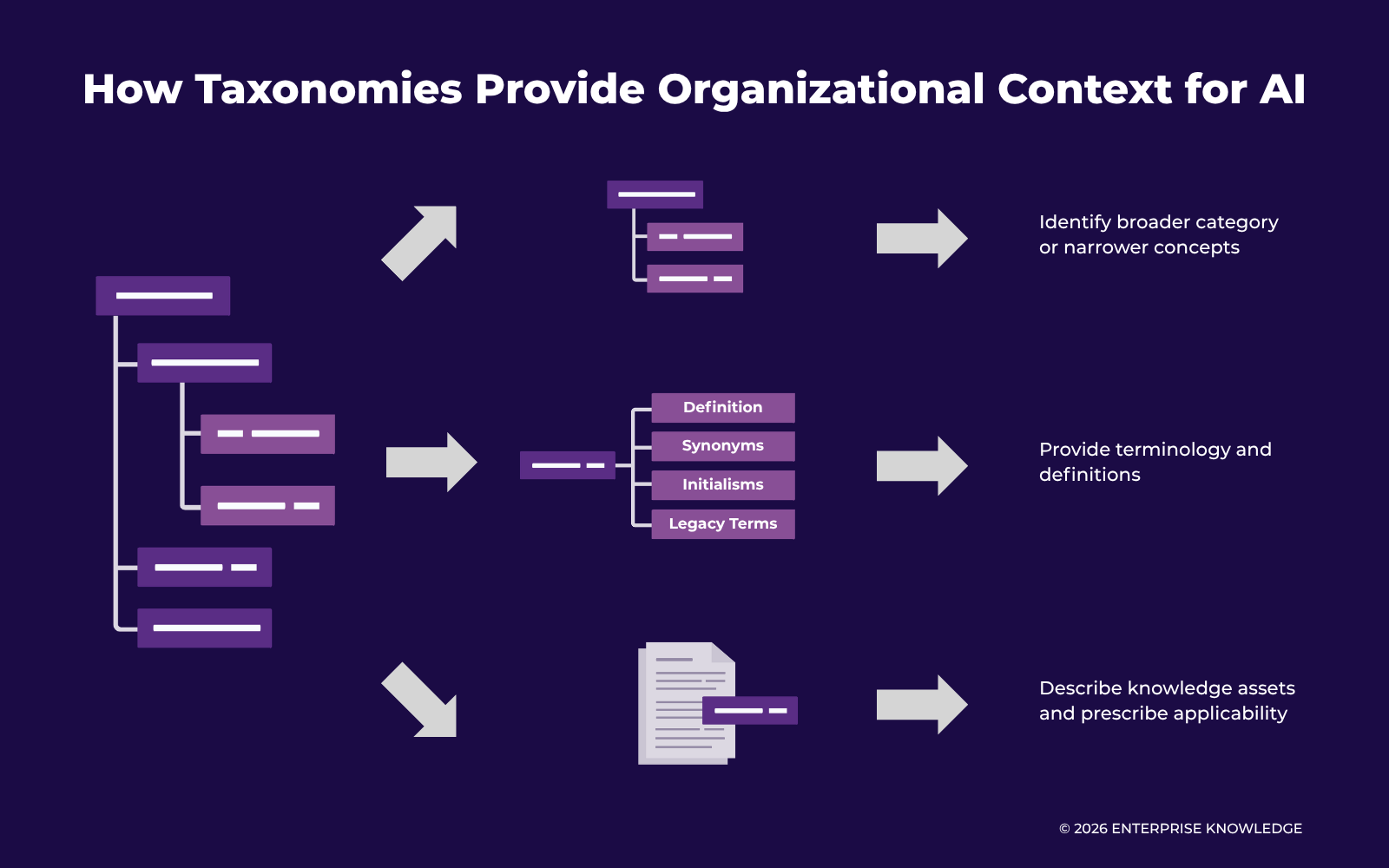
The most valuable taxonomies for AI convey context that is fundamental and unique to the organization. Often, these are operational taxonomies: controlled vocabularies that describe what an organization does and how it conducts that work. These include taxonomies like:
- Products, as the official list of items the organization develops or sells.
- Statuses or Stages, as the formalized workflow or the steps an organization follows.
- Regions, as the specific areas that the organization conducts work in.
As a formal, structured record of decisions and descriptors, taxonomies ground AI solutions in key operational concepts and terminology. The bottom line: use taxonomies to root AI solutions in the concepts and terminology you use to talk about what matters to your organization and how that work is conducted.
How Ontologies Enable AI-Readiness
Ontologies codify relationships and rules associated with organizational concepts, providing AI solutions with context for how entities are connected and leveraged within the organization; simply stated, ontologies specify the who, what, where, when, and how. Where taxonomies identify concepts and terminology used to describe how the organization works, ontologies define how the work is done. Ontologies expound on what entities are, when and where they are significant, who they matter to, what functions they support, or what actions they enable. Ontologies may also include rules that dictate what can or cannot be done. These elements of ontologies can be used in AI solutions to extend or constrain the organizational context available, defining what entities are and what rules govern them, providing connections to identify related facts, or using existing facts to infer new facts.
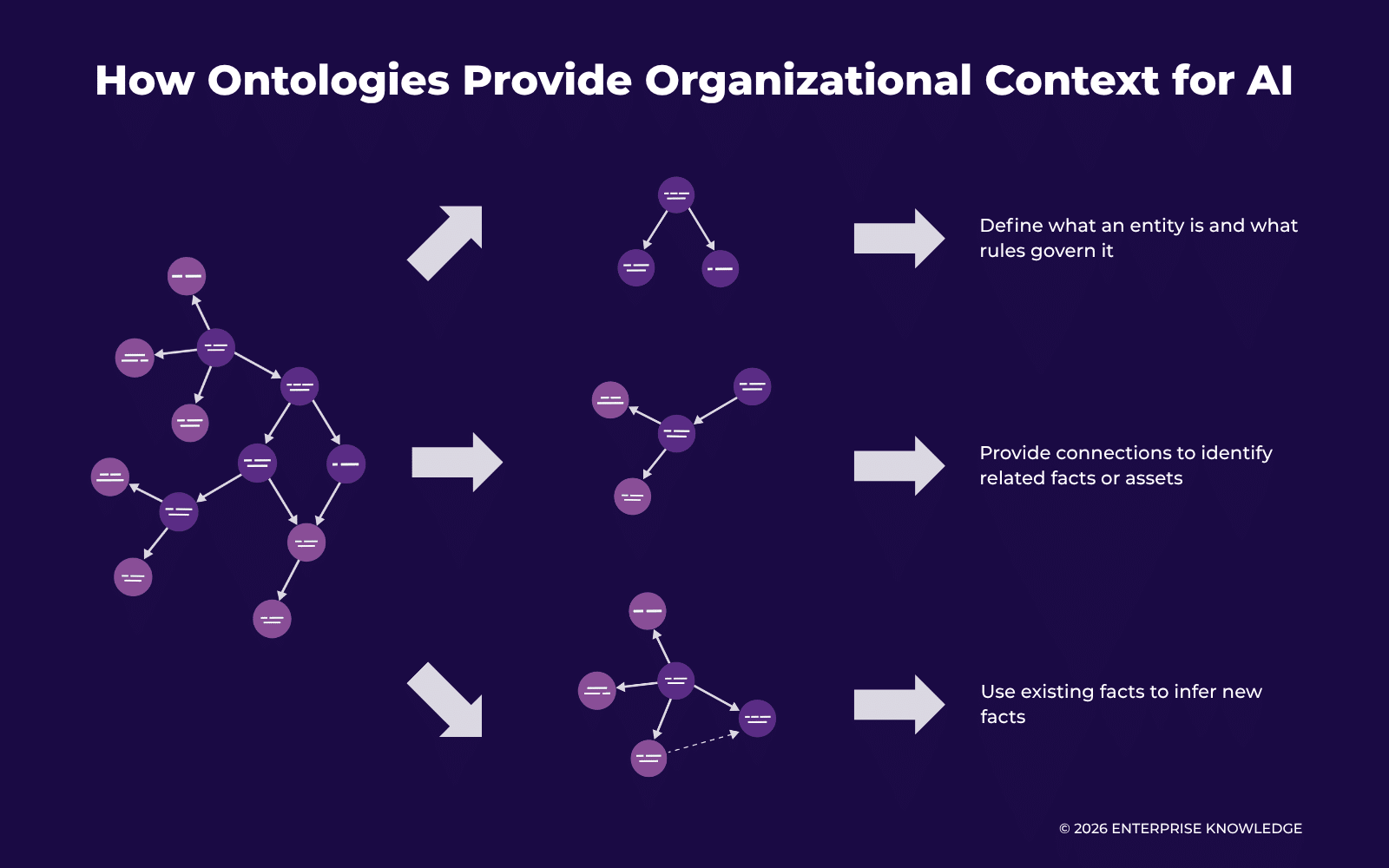
The most valuable ontologies for AI extend or constrain relevant organizational context reliably and traceably. Ontologies provide a repeatable framework for what is connected, how they are connected, and any rules governing when or how they are connected. This framework can be used by AI solutions to ensure organizational context is used appropriately (e.g., by identifying which aspects of organizational context should be referenced, or by providing the solution with a predictable, traceable path to additional information.)
As a formal specification of connections and rules, ontologies extend or constrain the organizational context that AI solutions can draw upon to derive outputs. The bottom line: use ontologies to specify the relationships and rules that determine how organizational context should be extended or constrained in AI solutions.
When to Use Taxonomies, Ontologies, or Both to Enable AI-Readiness
Both taxonomies and ontologies can help ground AI solutions in organizational context: taxonomies are better suited to conveying key operational concepts and terminology, while ontologies are better suited to extending or constraining key information sources. Importantly, these are different, not mutually exclusive, requirements.
Example: Consider an organization that sells technology products worldwide; some products are only sold in some regions, and most products are components of one or more product bundles. Taxonomies identify the official lists of products, product bundles, and regions. An ontology identifies the regional availability of product bundles based on the encoded logic of which products are currently available in which region and which products are included in which bundle.
AI solutions may be supported by taxonomies in isolation or taxonomies and ontologies in combination. Take the time to consider the level of organizational context you need to convey to your AI solutions. If you need to describe operational concepts and terminology, then a taxonomy will suffice. If, however, you need to convey more complex context, like the functions, dependencies, and constraints of how work should be done, then you will need an ontology, likely with a supporting cast of taxonomies. Alternatively, if your organization has steep requirements for entitlements and auditability, it may be necessary to adopt ontologies sooner rather than later. It’s a decision that should be weighed carefully to ensure you are focusing on the type of semantic model most appropriate for your AI use cases.
Ultimately, when organizational context is captured and structured appropriately, semantic models can enable more accurate and reliable AI solutions. EK has the requisite experience to help you identify and operationalize the right semantics for your AI solutions. Contact us to learn more.