


Your first AI use case goes live. The demo lands well. There’s excitement around the potential for what this could unlock for the organization. Weeks later, cracks start to show. The AI solution is surfacing outdated and duplicate content that was never ready or that anyone knew existed. People are seeing documents they weren’t meant to access. And without a shared definition of your business domains, something as basic as “product,” “revenue,” or “customer” has every system guessing at what it means. And nobody is quite sure who owns this process and whose job it is to fix these issues.
This is what happens when organizations go technology-first and assume AI will simply “work” once the platform is in place. As a recent Harvard Business Review article warns, “Leaders celebrate pilots, licenses, and training completion because they are easy to count. But those measures can create a false sense of progress: People appear busy with AI, while the work, operating model, and sources of value remain largely unchanged.”
Why Enterprise AI needs a Semantic Layer
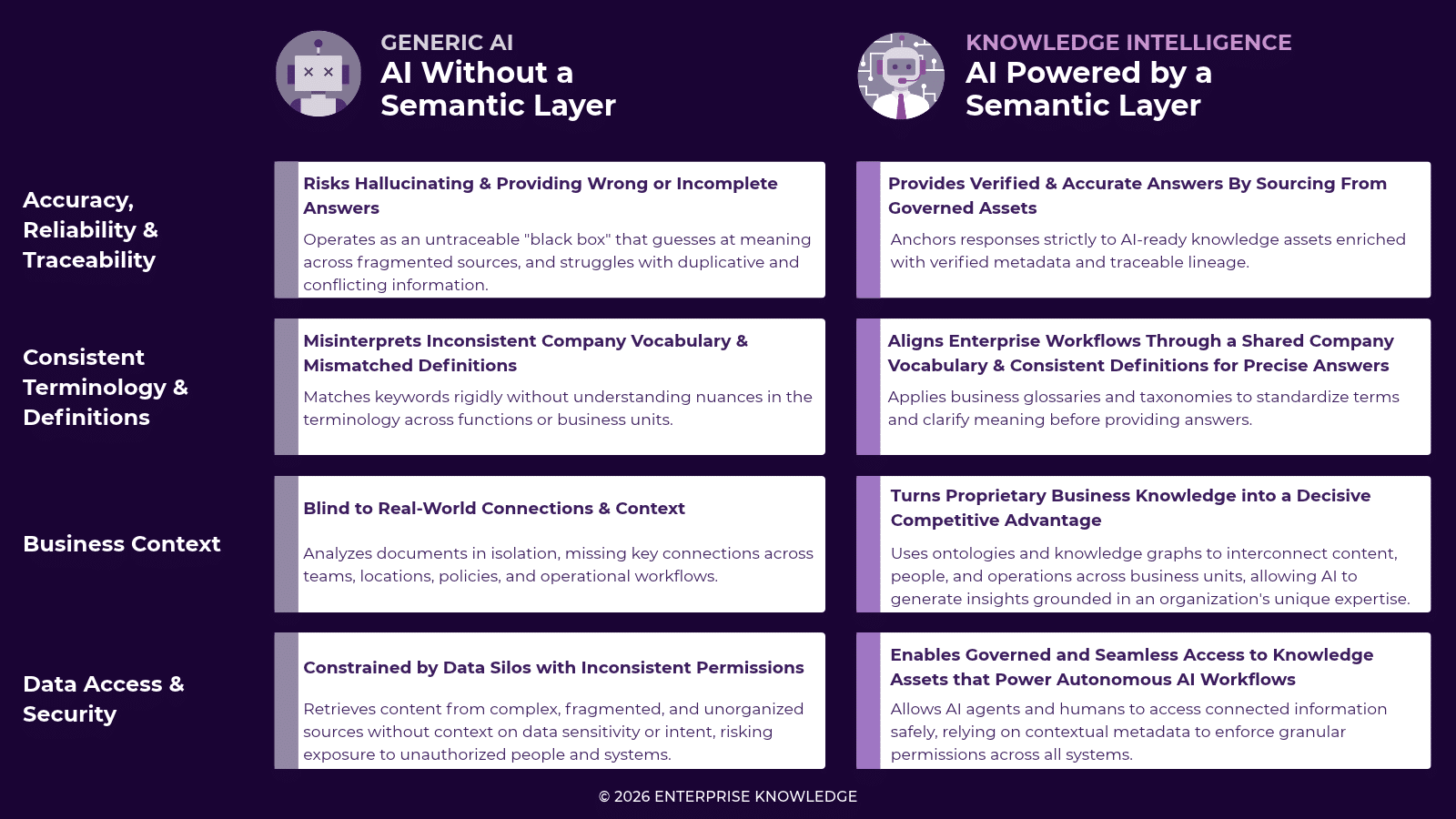
We hear a consistent pattern from organizations we work with: substantial investment is going into AI pilots and proof of concepts, with only a few of those materializing into production-ready solutions. Our Semantic Layer implementations tackle that gap directly, closing the distance between the data an organization has and the knowledge and shared meaning its business runs on.
But this work is not a one-time event. Semantic AI solutions require ongoing ownership after launch. The knowledge they consume ages from the day it’s published. Organizational knowledge and semantic models, such as taxonomies and ontologies, need continuous maintenance to reflect new products and services, shifting business lines and department structures, regulatory changes, enterprise rebranding efforts, etc. Entitlements and access need the same ongoing care. People join, change roles, move off projects, and leave; and every one of those changes has to carry through to what an AI solution is allowed to surface. AI only works the way an organization intends when people, processes, and technology are deliberately designed to work together, turning semantics from a one-time implementation into a governed, repeatable enterprise service.
As such, one of the most important investments your organization can make isn’t the next tool. It’s capability building. AI without a Semantic Layer may generate answers quickly, but AI with a Semantic Layer generates answers you can trace and trust. A Semantic Layer is only as strong as the program behind it. That’s why the real investment is the operating model for an Enterprise Semantic Layer (ESL) program, one that answers two deceptively simple questions:
- Who is accountable for this, and
- How does it scale past the first use case?
What is an Enterprise Semantic Layer Operating Model?
AI is a shared business problem. Solving it requires drawing on expertise and capability from across the enterprise that are aligned through a shared outcome, integrated workflows, and clear lines of accountability. Organizations that get this right stand to see a measurable difference:
- Greater return on your technology spend through the ability to scale effectively. Gartner research finds that organizations can reduce token costs by 50-70% by focusing on context engineering, governance, and operational practices.
- Tighter alignment between what you’re building and what the business needs. A BCG study found that 74% of companies have yet to show tangible value from AI investments. The companies that do realize value share a few traits. They focus on a small number of high-priority projects, an approach they anticipate will help them achieve twice the return on investment of their peers. They also invest in the organization over technology by following a 10-20-70 rule: 10% of their resources go into algorithms, 20% into technology and data, and 70% to people and processes.
- Solutions people actually trust and use. A global study of 48,000 people found that 66% of respondents use AI regularly, but only 46% are willing to trust AI systems. At work, many rely on AI output without evaluating its accuracy (66%) and are making mistakes in their work due to AI (56%). A Semantic Layer closes that gap by making every answer traceable: grounded in agreed-upon business definitions, linked to source systems, and explainable to the people relying on it. When users can check the work, they stop second-guessing it.
It’s easy to declare that “your organization needs to redesign its operating model.” It’s more complex to actually consider what that means and what the pragmatic components look like. Before going further, I want to disambiguate scope.
The term “operating model” means different things at different scales. At Enterprise Knowledge, we’re talking about the operating model that governs and scales an enterprise Semantic Layer.
| An enterprise Semantic Layer (ESL) operating model ensures knowledge and semantic models are built, findable, standards-based, machine-readable, and actively maintained, so any team or system can use them rather than building its own answer to “what does this data mean.” |
The shared foundation that an enterprise Semantic Layer provides is what makes AI solutions faster to deliver, more accurate, and more trustworthy. It’s precisely what a technology-first approach skips.
Taking an Operating Model-First Approach
Shifting from a technology-first mindset to an operating model-first approach when implementing a Semantic Layer requires deliberately aligning people, processes, and technology from the start. To design a model that turns semantics into a governed enterprise capability, organizations must address three foundational questions:
- What are you trying to accomplish?
- What are the critical factors or enablers?
- What needs to change? What are the core components?
What Are You Trying to Accomplish?
Organizations are rapidly integrating AI into workflows to promote efficiency and accelerate work, but many are finding that the tools they deploy lack the organizational context and explainability needed to ensure accuracy. Their workforce or customers aren’t simply looking for responses; they need answers that are grounded in reliable sources that they can act on with confidence.
That work doesn’t belong to any one team or technology. It requires domain experts to describe what people are searching for and why. It requires knowledge, data, and content owners to provide and ensure the right knowledge assets are available and up-to-date for a user’s query. It requires semantic modeling teams to map and align the language of their organization so the right results reach users. It requires security, compliance and legal teams to set access policies and permissions so users see only what they’re entitled to. And it requires the technical and development teams to build the solutions themselves. Other roles are required too, but the point is this: organizations need to get clear on what it is they are trying to accomplish and the value they want to deliver, and then determine who needs to be involved to realize that vision.
This is the shift my colleagues describe in their article, “Shifting to an AI-first Operating Model”: realigning team structures and reporting lines around end-to-end accountability for value delivery. Traditional, siloed team structures optimize for functional output, and for some functions that still makes sense. But accelerating the integration of reliable AI requires reorienting teams around the collective outcome they produce: AI that is accurate and explainable.
When we worked with a sovereign wealth fund to update their Operating Model, we spent time with their senior leadership team before any redesign work began. We clarified the outcomes we were designing for and any operational shifts they would need to enable across investment outcomes, execution effectiveness, and capability. By defining why change was needed in their specific context and what a new operating model had to enable, we gave them an anchor for every decision that followed.
What are the Critical Factors or Enablers?
With that value anchor in place, we next consider the conditions that have to exist for an ESL operating model to hold, and for a cross-functional group to actually deliver on the defined outcomes. Some are familiar and hold true for any enterprise initiative: executive sponsorship, a clearly defined business problem, and a design that is compatible with how an organization already makes decisions and distributes autonomy.
What’s distinct in building and scaling a Semantic Layer is the ways in which those conditions get tested and can break down. Sponsorship will always matter, but with an enterprise Semantic Layer program, the funding has to account for shared costs, such as platform licenses, token usage, specialized services – costs that no single business unit wants to absorb. Similarly, financial incentives tied to business unit performance can quietly reward a culture of knowledge hoarding over contributing to shared semantic assets, and create resistance amongst business leaders to deploy resources that might be perceived as operational overhead.
There are also ownership questions that many organizations haven’t yet addressed: Should specific domains own the semantic models that reflect their expertise? Who owns the Semantic Layer overall as an enterprise capability ? And what type of decision-making body—with real authority—can be stood up to prioritize competing demands (e.g., business use cases, shared semantic assets, standards and processes that downstream teams are expected to adopt) as well as resolve conflicts over definitions (disputes that might otherwise go unresolved and erode trust in the organization’s AI solutions). Answering these questions is what turns an operating model from a conceptual diagram into something that holds under pressure. With answers in place, the next question becomes what has to change.
What Core Components Need to Change?
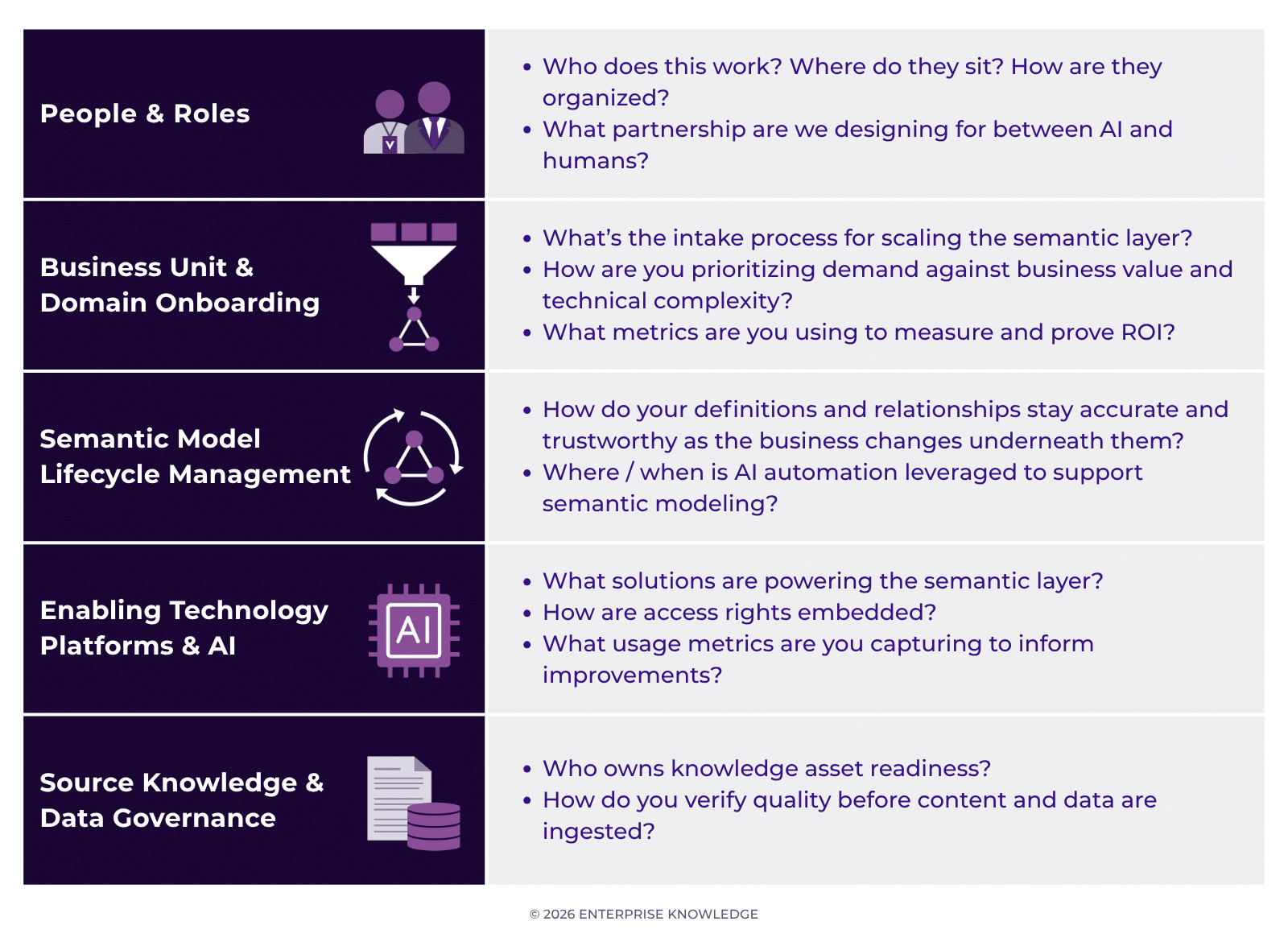
At the beginning of this article, I noted that an enterprise Semantic Layer operating model gives organizations a standardized, governed source of shared business meaning that accelerates the delivery and improves the accuracy of AI use cases. Semantic work is no longer delivered as a bespoke, one-off artifact per system or project. Rather, it becomes standing infrastructure—something that teams request against and build on top of, the same way they’d consume any other enterprise service. With this in mind, when we’re designing an ESL operating model, we’re building toward enterprise consistency, while preserving the autonomy teams need to model entities specific to their line of work. So what’s the delta? What needs to change to enable that capability?
The change happens when organizations clarify the following questions:
It’s one thing to answer these questions and stand up the right roles and integrated workflows; it’s another to enable the behaviors and actions that mobilize them. What makes this type of change hard is twofold:
- What you’re asking people to give up – control over a particular area.
- What you’re asking them to take on – a sense of collective responsibility for developing and curating knowledge and the semantic models behind them.
Neither of those shifts happen because a new structure says they should. The success of the ESL operating model lies in making the shared path—the shared work—faster and easier than the individual paths people were on before, where those who are giving up local control can clearly see something better in return.
That’s why at EK, change enablement is a core component of this work from the start. One principle that guides our enablement work is identifying where changes can be embedded into the flow of daily work. Adoption increases when we reduce friction and lower the barriers to participation: automating parts of knowledge capture, introducing semantic standards in ways that complement existing legacy systems and bespoke applications, and making it simple and intuitive for developers to use the Semantic Layer and contribute to it. When the shared path is built into how people already work, giving up control stops feeling like a sacrifice and starts feeling like the easier way to get the job done.
How Do You Get Started?
It’s critical to avoid defaulting to drawing organizational boxes and reporting lines as a first step. Start with mapping the flow of value, and then build to enable it. This allows you to come up with different operating model options to accommodate different organizational needs. The ultimate value of this approach—compared to a technology-first approach—manifests across four levels:
- Semantic investment is directed towards defined business needs. Leadership can answer what the organization is getting for what it’s spending.
- Consumers and AI systems inherit trusted meaning. Every new use case starts from a shared, governed foundation instead of rebuilding its own interpretation of the business. Answers are consistent across AI solutions because the definitions underneath them are the same ones, and they’re explainable because the lineage to the source system is intact.
- People get their time back. The team who owns the Semantic Layer is directly plugged into the business demand, resulting in more efficient development of reusable models. Augmenting ESL workflows with AI further reduces the demand on experts, who are only pulled in for decisions that require their judgement, rather than for every request that touches their domain.
- Enablement is built in. Because the operating model is designed to complement how work and decisions currently move through the organization, new practices fit into what people are already doing, rather than add extra obligations.
A technology-first approach can produce a working tool. But an ESL operating model produces an enterprise capability that results in AI solutions that your people are more likely to embrace. Learn more about how we can support your organization in developing a sustainable operating model to scale and evolve your AI solutions or reach out directly with any questions.