



Scaling Your AI Pilot with the Right Contextual Foundations
There’s a rush to build AI solutions: recommendation engines, chatbots, analytics dashboards, and virtual agents. But chasing shiny tools, without understanding the full picture can be risky. The organizations that truly get ahead are those that recognize the foundation: content. AI-Ready Content is composable, provenance-bearing, and semantically complete. When content is structured, governed, and treated as a strategic asset, you unlock value no matter what AI trend wins. Content is the common denominator, and betting on it means betting on yourself.
In this expert analysis, two of our senior consultants, Emily Crockett and Elliott Risch, will be answering the question – how do I prepare my organization’s content for AI solutions?
What is AI-ready content and why does it matter?
 Emily Crockett
At the end of the day, making content AI-ready means focusing on three key things:
- Machine-readability
- Disambiguation of language
- Deduplications and normalization of assets
Making the content machine readable essentially means content has been structured and tagged in such a way that a machine (aka AI) can interpret the content meaningfully.Think about it like this: imagine you’re looking at a recipe and there is no list of ingredients. You are forced to read through the steps to determine what you need to gather to start the recipe. As a human, this would be incredibly frustrating, and there is a relatively high probability that you would miss an ingredient. As a machine, an absence of logical structure means a high likelihood of ingredients being missed or misinterpreted. This is where the disambiguation of language comes in. A human may be able to understand that the 2 cups of flour mentioned in the ingredients list refer to the 1 cup intended to coat the counter while kneading bread, and 1 cup intended to be added to the dough. Without the careful disambiguation of the intention of this ingredient, it’s likely an AI interpretation of this recipe would add all 2 cups to the bread, creating an overly dry bread. The final focus involves eliminating any duplicated, redundant, or conflicting content. Even before AI went mainstream, organizations were struggling with content and information overload and no clear source of truth. An employee may find one document that says “submit timesheets to John Doe” and another document that says “submit timesheets to Jane Doe” and then have to either track down a person who could definitively say which document is right, or use context clues such as the date to guess which one is right. A machine may be able to use context clues like the date the document was created or modified, but it can’t ask the person who created the document.
 The concept of “Garbage in, Garbage out” has been around since the early days of computing, and still rings true today. In order to have a scalable, sustainable AI program, you have to clean up the garbage and do the work of preparing content for AI. As an added benefit, many of the steps to improve AI outcomes also improve the human experience and important principles like adherence to accessibility standards.
 Elliott Risch
Making content AI-ready is about turning possibility into capability. Once content is structured, tagged, and governed, machines gain a consistent way to interpret meaning, enabling systems that can automate compliance reviews, power intelligent research assistants, or orchestrate complex workflows across departments. We can now build AI that doesn’t just understand language but retrieves the right information in full context, synthesizes knowledge across sources, and takes decisive action toward well-defined goals. We can create virtual agents that don’t just answer questions or call APIs, but transparently explain their reasoning and collaborate as peers. These advanced capabilities, however, remain out of reach without the foundation that unlocks them: precise metadata and highly networked semantic models.
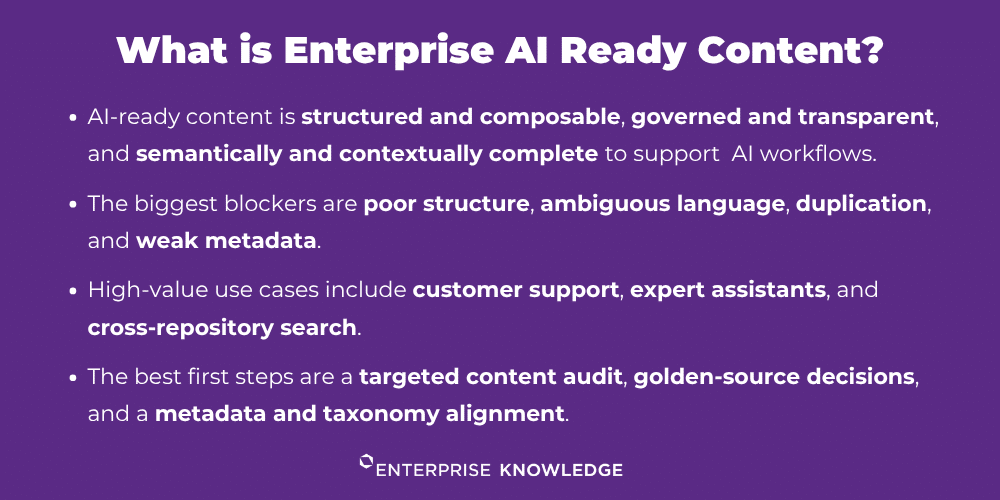
So what does “AI-ready” actually mean? Content is AI-ready when it can serve as reliable context within an AI workflow, not just discoverable, but genuinely usable. That means it is composable, so systems can assemble exactly the right pieces for the task at hand rather than returning hundreds of irrelevant results. It carries its own provenance, so an AI assistant can tell you not just what the answer is but where it came from and whether it’s still current, instead of hallucinating a confident response with no grounding. And it is semantically connected to related content, so a compliance review can surface every relevant policy, exception, and precedent without a manual hunt across siloed repositories. Above all, AI-ready content is designed around who will consume it and how, not organized solely by who created it. Without these qualities, AI systems are left guessing, and guessing at enterprise scale is how organizations get confident wrong answers instead of trustworthy ones.
Think of it as laying the foundation for a standardized environment. The places where humans are already being surpassed by AI agents are development environments like Cursor, Windsurf, or VS Code. Their shared advantage is that they are highly structured, rigorously documented, and fully standardized, which is shown to dictate whether contemporary agent orchestration will succeed. Your enterprise information environment must reach that same level of rigor if you expect machines to perform with the precision necessary to effectively work alongside your skilled workers. The lift may seem large today, but it is trivial compared to the power it unlocks: your newest hire could perform with the same proficiency as an employee with five years of experience on day one. Right now, treating content as AI-ready may feel optional. Soon it will be mandatory. And the organizations that prepare now will be substantially more productive, and far sooner, while the rest are left scrambling to catch up.
What roles help prepare content for AI?
Emily Crockett
Roles we often see helping prepare content for AI are folks like Content Strategists, Content Engineers, Content Systems Managers, Taxonomists, and Content Owners.
- Content Strategists often address the why of content and should have a good idea of what content even exists in an organization and which segment of content would be the best place to start preparing.
- Content Engineers think about how the content should be prepared, how the content is structured to be human and machine readable.
- Content System Managers act as a digital librarian for content systems like DAM, PIM, CMS, etc. and can often identify metrics and analytics to support content strategists, the current state of the content to support content engineers, and can assist in curating the prepared content for AI.
- Taxonomists and Ontologists identify and create the right metadata tags and relationships to describe the content which ultimately supports the interpretation by AI.
- Content Owners and Domain SMEs are an integral part of an AI endeavor because they should be one of the ultimate authorities on any changes that are proposed, and can provide important insight from a business or SME perspective.
Elliott Risch
Preparing content for AI is all about standing up and sustaining context strong enough to buttress your automation aspirations. If you expect agents to operate with the precision, trust, and composability of today’s best development environments (i.e., where the most successful agents operate), then you need a workforce deliberately building a context that is standards-based, seamless, semantic, secure, and separable at will.
To achieve this, the crucial hires over the next five years are going to be knowledge modelers and context engineers. These are the people best able to work with your existing tech stack and workforce to (1) capture tacit SME knowledge, (2) encode it into semantic models, and (3) use said semantic models to integrate your existing repositories in a way that ensures every future connection is standardized, secure, and reusable for humans and machines alike. Without them, you are effectively betting against your own institutional memory or locking it within a vendor’s solution (that will extract value from you for years to come while providing you with the barest of capabilities).
But roles alone do not deliver. Governance determines whether the context stays usable past launch. Organizations that succeed treat metadata stewardship, taxonomy councils, lifecycle SLAs, prompt/model/context governance, and entitlements as minimum viable controls. Without that layer, your “AI-ready” investment will decay into the same swampy mess most CMS environments live in today.
Which AI use cases depend most on AI-ready content?

Emily Crockett
Suppose you run a customer service call center and want to support your customers and agents in solving problems by creating an Agentic AI solution. Often Customer Service is a high-tension environment, so it is incredibly important that both audiences are getting the correct information and are supported throughout what are often complex processes and workflows. In this case, it is worth the time and effort to archive old or outdated content, structure and componentize content, and overall take careful steps to prepare content to be fed into the AI solution. For another example, maybe your company has a storied history, and has an abundance of historical analog records in addition to more modern digital records that you want to tap into for a predictive AI solution. In this case, you may want to digitize the analog records and run OCR on the digital files to be able to use the content alongside the digital records, but it probably would not be worth the time and effort to retroactively componentize or transform those analog records as preparation. Ultimately, it’s important to get a holistic view of the content, the solution, and the goals of an organization to make strategic decisions about the best way to prepare.
An enterprise content ecosystem is filled with knowledge assets that fall on a wide spectrum of variables like internal or external, knowledge or information, digital or analog, etc., so it’s incredibly important to have a full picture of what you’re dealing with (through a process like a content audit!) before embarking on the AI journey. Part of the reason we suggest a Content Strategist as an important role in a project like preparing content for AI, is to understand the goals and audiences of different segments of content in your organization. Not all content is created equal in terms of long term value, and it is important to right-size your preparation efforts to both where your content is on the Content Management Continuum and the AI solution you’re trying to enable.
Elliott Risch
In my mind, it’s less about particular use cases and more about the capabilities inside them. The AI ready content dependency spikes wherever you need: precise retrieval and grounding, entitlement-aware routing, step-wise procedural execution, or cross-resource synthesis with traceable provenance. When those capabilities are in scope, “AI-ready” content (authoritative, de-duplicated, componentized, richly tagged, and policy/entitlement-encoded) stops being optional.
Nevertheless, here are examples of cases where a high degree of precision means you’ll need a high degree of content readiness:
Agentic Customer Support

Dependency: Componentized procedures, tagged with SKOS vocabularies, aligned to policies and entitlements.
Example: A health insurance member asks “Is this procedure covered under my plan?” and the agent needs to reconcile the member’s specific benefit tier, the provider’s network status, and the most current formulary or coverage policy to give a single trustworthy answer, not three contradictory ones.
Risk if not AI-Ready: Hallucinated steps, conflicting instructions, or answers delivered to the wrong customer segment.
KPI: First Contact Resolution (FCR) and policy-adherence error rate.
Expert Assistants for Knowledge Workers

Dependency: Standards-based semantic models (RDF, OWL, SKOS, SHACL) that unify enterprise content into a machine-navigable context.
Example: A pharmaceutical regulatory affairs specialist needs to determine whether a proposed label change triggers a new FDA submission, a question that requires synthesizing guidance documents, prior submission history, and current regulatory standards rather than forcing the specialist to chase down each source and validate the machine’s work themselves.
Risk if not AI-Ready: Workers left validating machine output manually, negating promised productivity gains.
KPI: Time-to-find and time-to-resolution across critical tasks.
Search & Synthesis Across Entitled Repositories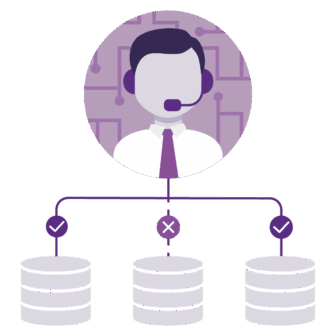

Dependency: A single, governed semantic layer that enforces entitlements and enables findability, accessibility, interoperability, and reusability of enterprise content and data treated as a unified whole.
Example: A wealth management compliance team asks “Show me every client communication in the last 90 days that referenced projected returns” and expects the system to search across email, CRM notes, and advisor portals while respecting information barriers between business units, not surfacing results the reviewer isn’t entitled to see.
Risk if not AI-Ready: Breach of sensitive data or fragmented results that undermine trust.
KPI: Duplication reduction and reuse rate of authoritative assets.
How do you get started preparing content for AI?
Emily Crockett
Before starting any journey into AI or preparing content to enable AI, it is important to take the time to plan. Define the goals and objectives your organization is looking to achieve, identify key problems you are looking to solve, and establish clear direction or a guiding vision for the journey. These overarching inputs can then shape any discovery or analysis that is needed on the content. This discovery should include answering basic questions like:
- How much content are you dealing with?
- What systems and repositories does the content live in?
- What does the structure of the content look like?
- What metadata exists?
- How are people using the content?
- What relationships exist between content?
Once you’ve collected this information, and analyzed it within the context of the goals and objectives defined earlier, you can establish an iterative phased approach to preparing the content. This can take many forms, but generally this will prioritize segments of content and identify tactical actions to perform on the content to prepare it to feed your AI solution. The final step is to think about the future of your content. Content has a natural tendency towards entropy (it is not a coincidence that the most common phrase we hear when people describe their content is either “Wild, Wild, West” or “dumpster fire”) so it is important to prepare now for how you will handle that entropy. This future focused step should take into account both how you will maintain the content you’ve just spent time preparing and how you will handle the creation of your content in the future such that it is scalable and AI-ready without retroactive intervention.
Elliott Risch
Step zero is honesty: being able to answer, “where are you today; where do you want to be tomorrow?” Most enterprises are still in ad-hoc or “organized but fragile” stages. The path to a context that supports high-grade human-agent interactions and tasks faces a steep maturity curve every organization will traverse eventually, whether your organization will face it proactively or under duress is a choice you need to make now.
If you choose to face it proactively, here are some first moves that will make a difference:
STEP 1: Pick one priority use case and one audience. Focus concentrates value.
STEP 2: Run a targeted content inventory and quality audit focused solely on that use case. You need to know what you’re actually working with.
STEP 3: Enforce a golden-source and de-duplication policy within the scope of the inventoried content. Decide what is authoritative and scrap the rest.
STEP 4: If targeting high-grade solutions, define core metadata requirements and establish a structural taxonomy for alignment. Create a substrate for semantic alignment.
From there, pace your program on a 3-month PoC, 6-month MVP, 12-month scaled implementation rhythm. If you’re attempting to build highly structured context that will support advanced use cases (i.e., like those I listed above), acknowledge the skills gap (e.g., most orgs lack graph/semantic experience in-house) but frame it correctly: this isn’t “another database,” it’s a strategic lens that clarifies operations. Done right, it replaces slow ticket queues and analyst bottlenecks with agents that can instantly contextualize, answer and act.
Conclusion
The message is simple: high-grade agents without high-grade context are snake oil; high-grade context rests upon high-grade content. There are certainly lower-risk use cases where pre-defined models can deliver value with limited organizational context. But when enterprise AI is expected to reason across complex internal content, honor organizational policies and entitlements, and support decisions or actions with real business consequences, any vendor offering an “agent framework” without demanding a comprehensive content and data audit plus integration roadmap is selling you a demo, not a durable solution.
The organizations that are able to successfully pop the AI bubble will be those that stop treating content as a static byproduct of work and start treating it as a strategic, living asset. The velocity of content creation is not slowing down any time soon, so it is imperative to start shifting now to an operating model that enables nimble, continuously refined content that is AI ready from its creation to ultimate archival.
This isn’t easy, but it is essential. And the sooner you begin, the less you’ll be forced to play catch-up later on. Start with a two-week content readiness scan. That’s enough to determine where your context is fragile, where governance is absent, and where quick wins can prove out value fast. From there, you can set a trajectory toward agents that don’t just work, but work with you scaling your weakest performer today into the strongest contributor tomorrow.
As a semantic layer and enterprise AI consultants, Enterprise Knowledge helps organizations cut through the noise and build the content foundations that make AI actually work. Whether you need a content readiness assessment, a semantic strategy, or hands-on help preparing your content to become context for agentic workflows, our consultants bring the expertise to move you from aspiration to implementation. Contact us to start with a focused content readiness scan and find out where your quickest wins are hiding.