


Introduction
Organizations have access to a broad and rapidly expanding set of AI capabilities, from systems that monitor and analyze data to tools that generate content, automate decisions, and orchestrate complex workflows. Despite this abundance, many organizations struggle to apply these capabilities in a structured, scalable way. Certain patterns get overlooked, others get misapplied, and the result is AI adoption that delivers isolated wins but falls short of meaningful operational impact.
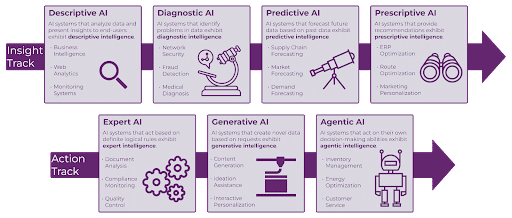
A useful lens for navigating this landscape is to think about enterprise AI in two complementary tracks: the Insight Track and the Action Track. The Insight Track, which we explored in Part I, accounts for AI capabilities that help organizations understand what is happening in their data and why. The Action Track is where those insights are translated into decisions, outputs, and outcomes.
The Action Track appears in three progressive patterns: Expert AI, Generative AI, and Agentic AI. Each stage builds on the last, advancing toward a closed-loop enterprise system that enables consistent, scalable, and well-governed decision execution. Understanding how these patterns work and how they differ is essential for organizations looking to move beyond Proofs of Concept and into production-grade AI.
Expert AI
Expert AI is a specialized instance of the Action Track focused on structured, rule-based decision execution. These systems apply defined logic deterministically, using consistent inputs and outputs to deliver repeatable decisions at scale. Their value lies in reliability, producing consistent, measurable results that integrate seamlessly into existing enterprise workflows. In enterprise settings, Expert AI capabilities are best understood through the use cases they enable, such as:
- Document analysis and triage: Rule-based matching of users to relevant resources, courses, or products based on their profile, behavior, or performance history. Automatically classifying incoming content, flagging exceptions, and routing work to the appropriate team or process.
- Compliance monitoring: Continuously evaluating records or transactions against defined rules and surfacing violations without manual review.
- Recommendation engines: Rule-based matching of users to relevant resources, courses, or products based on their profile, behavior, or performance history.

What makes these systems effective is not the model alone but the organizational context that grounds it. Expert AI works best when it is based on specific knowledge systems – like taxonomies, knowledge graphs, and ontologies – that add context and show how the organization organizes its content, data, and decisions. EK has written extensively on how injecting organizational knowledge into AI systems improves relevancy, accuracy, and explainability across enterprise applications. Without this foundation, outputs tend to be generic or inconsistent and difficult to explain to end users and stakeholders.
Consider a large global digital marketing and technology firm that manages consumer data across more than 2 billion records. Their core challenge was deduplication at scale. EK created an Expert AI solution using a knowledge graph that included rule-based matching algorithms to connect records of the same person from different data sources, which was continuously checked and improved with input from subject matter experts and business stakeholders. The result was a 70% reduction in unique records and a fully automated process that continues to expand as new data is ingested.
Expert AI is often underestimated, treated as basic automation rather than a foundational AI capability. When grounded in the right organizational and domain context, these systems deliver consistent, explainable decision logic that more advanced AI patterns depend on. Organizations moving toward generative or agentic AI will find that the quality of their Expert AI layer has a direct impact on how far those investments can go.
Generative AI
Generative AI serves as the Action Track’s content engine, creating and transforming language, structure, and artifacts in response to enterprise needs. Unlike Expert AI, which executes predefined rules, Generative AI produces novel outputs like drafts, summaries, classifications, taxonomies, code, and documentation by drawing on the context and instructions it is given. Its value lies in scaling knowledge work that would otherwise require significant human effort to produce consistently and at scale.
In enterprise settings, Generative AI capabilities are best understood through the use cases they enable, such as:
- Content generation and transformation: Drafting, summarizing, and reformatting documents, reports, and communications at scale.
- Taxonomy and classification development: Generating and refining controlled vocabularies, risk categories, and metadata schemas grounded in organizational language.
- Knowledge base augmentation: Extracting and structuring insights from unstructured sources to enrich enterprise knowledge systems.

The effectiveness of Generative AI depends on how well outputs are grounded in organizational context. Without semantic structure, generated content can introduce inconsistency rather than reduce it. As semantic AI consultants, EK prioritizes adding context to content in the Semantic Layer, resulting in content that is structured, semantically enriched, and enables AI-generated outputs to be accurate, consistent, and reusable across the enterprise.
For a global investment bank struggling with inconsistent risk language across teams and geographies, EK developed a Generative AI-assisted process to expand and refine a risk taxonomy. Starting with topic modeling to group risk descriptions by semantic similarity, EK used prompt engineering to generate controlled risk topics for each cluster. A human-in-the-loop workflow ensured that subject matter experts owned the taxonomy and continuously refined the outputs, resulting in a consistent, machine-readable vocabulary that could be reused and aggregated across the organization.
Generative AI is frequently misapplied when organizations treat it as a standalone content tool rather than a capability that requires semantic foundations to perform reliably. When integrated into a well-governed knowledge architecture, it becomes a scalable engine for structured knowledge work that grows more accurate and useful as the underlying organizational context matures.
Agentic AI
Agentic AI shifts from generating answers to autonomously completing tasks. These systems plan, use tools, gather context, execute actions, and adjust based on results. Their value lies in orchestrating end-to-end workflows that would otherwise require significant human coordination, enabling organizations to move from insight to action without manual handoffs at every step.
In enterprise settings, Agentic AI capabilities are best understood through the use cases they enable, such as:
- Inventory and operations management: Autonomously monitoring supply chain conditions, detecting anomalies, and triggering corrective actions based on defined thresholds.
- Compliance and investigation workflows: Orchestrating evidence gathering across documents, tables, and data systems to produce grounded, auditable findings.
- Customer service and case resolution: Routing, researching, and resolving inquiries end-to-end by connecting to the right knowledge sources and executing follow-on actions.

The effectiveness of Agentic AI in enterprise settings depends on access to high-quality context. Agents that are not grounded in accurate, well-structured organizational knowledge are prone to misguided actions that are difficult to trace or correct. Most enterprise workflows also span multiple data and content types, meaning agents need a way to retrieve and reason across modalities like documents, tables, diagrams, and structured data within a unified retrieval and reasoning layer. To learn more about the organizational foundations required for Agentic AI to perform reliably, check out our blog When Should You Use An AI Agent?
EK developed a semantic RAG agentic workflow built on a unified knowledge graph to help a global foundation evaluate the impact of investments on its strategic objectives. The agent autonomously connected cross-document queries with relevant structured and unstructured investment data, tracing each answer back to its source through explainable AI. The result was a scalable, containerized solution that delivered precise, explainable insights to executive stakeholders as well as a generalizable architecture ready for broader application across the foundation’s data ecosystem.
Agentic AI is the most advanced pattern in the Action Track and the most demanding to implement well. Organizations that deploy agents without the right semantic foundations often find that the gaps in their knowledge architecture become harder to manage at scale. When those foundations are in place, agentic systems can orchestrate complex, multi-step workflows with the consistency and auditability that enterprise operations require. An Observability and Evaluation (O&E) platform becomes a critical enabler at this stage, providing the transparency needed to verify that agent workflows are meeting strategic objectives and scaling safely across the enterprise.
Closing the Loop
The Action Track represents the operational side of enterprise AI, where patterns, decisions, and generated content translate into measurable outcomes. Expert AI operationalizes structured decision logic, grounded in the organizational context that makes those decisions reliable and explainable. Generative AI scales knowledge work that would otherwise require significant human effort, producing consistent outputs when anchored in the right semantic foundations. Finally, Agentic AI orchestrates end-to-end workflows autonomously, connecting the right tools, data, and reasoning to deliver results that are traceable and auditable.
Each pattern builds on the last. Organizations that invest in Expert AI create the decision infrastructure that Generative AI can extend. Organizations that structure and govern their knowledge assets create the context that Agentic AI needs to act reliably. The progression is not just technical; it reflects the maturity of an organization’s data, content, and knowledge architecture. Understanding that maturity is a critical starting point, and EK’s Enterprise AI Readiness Assessment provides a structured way to evaluate where those foundations stand at your organization.If you are considering how to start or scale your Enterprise AI, EK can help design your Action Track roadmap, covering semantic foundations and model workflows, as well as production architectures and governance. Contact our team to discuss your use cases and develop an approach that delivers measurable results beyond Proofs of Concept.