


Knowledge Portals first came into prominence in the early 2000s. These initial portals were a collection of static links to information on everything from HR systems to company policies and communications. It was a single location to access the systems that stored the information people needed, typically with both classic search and browse features to aid in findability. However, limited features and functionality, as well as issues with the underlying content and data (knowledge assets) being surfaced, resulted in few major successes.
About seven years ago, Knowledge Portals regained prominence with the introduction of knowledge graphs. Knowledge graphs provided a map to information assets across the enterprise. Organizations that adopted these graph-based portals suddenly had a single, consolidated view of the most important people, places, and things respective to the company. These new Knowledge Portals removed application silos and enabled people to view both structured and unstructured information in a single place. This new approach broke down application silos and empowered business users to make more informed decisions.
It is now time for the next generation of Knowledge Portals. These new portals build on what is already in place with taxonomies, ontologies, and knowledge graphs, powering dynamic views of information by augmenting this information with the personalized answers that AI tools can provide. They need to provide explainable AI that builds trust in the information users receive. These new AI-powered Knowledge Portals should be a glass box, providing a 360-degree view of a company’s key assets while summarizing key points across them. Graph-based portals once served business users with the information they need to make informed decisions from a single location. Now, these new AI portals are transforming graph portals from an information aggregator to a proactive recommendation tool. Imagine working in a manufacturing company and being able to see all the products that rely on parts procured from a single manufacturer, in one place. Then imagine that AI summarizes the risks of supply chain failures and provides recommendations for other parts manufacturers to minimize these risks in the same view. The AI could also consider global market conditions to recommend additional ways to protect the product company from supply chain disruptions. AI turns the Knowledge Portal from an information source to a proactive partner, suggesting solutions to potential problems. The portal and its semantic back end, make answers explainable and easily validated.

What is an AI Knowledge Portal?
AI is being thrown around as the solution to everything. This creates confusion for organizations trying to implement AI solutions and has led to numerous high-profile AI failures. Equally, both the terms of “knowledge” and “portals” have been used loosely, with many varying definitions. As such, it is important to define what an AI Knowledge Portal is and what it isn’t.
An AI Knowledge Portal is a graph-based platform that enables users to search for or browse information about their organization’s most important assets. Application, database, and document silos are removed, allowing an unfiltered understanding of the work an organization does. If you are looking for information about an employee, it is all in one location. If you are looking for information about a product or a customer, it is also available in a single location. The AI component of these portals builds on this strong framework to provide dynamic answers that align with the rest of the portal’s information. The portal also allows users to ask questions similar to the original chatbots, but the answers are built on context, the results are explainable, and users can browse the rest of the portal to better understand the context behind the answer. The black box becomes a glass box, giving the user greater confidence in what they are seeing. If an answer includes information about an employee, product, or customer, it provides links to the portal pages that show all critical information about the customer. This seamless experience blurs the distinction between asking the LLM questions and browsing the company’s information, providing users with everything they need in a single place.
Many product vendors have now integrated AI into their systems and are selling them as Knowledge Portals. This is typically marketing hype and not real. An AI Knowledge Portal must have two characteristics:
1. They aggregate information from multiple source systems.
2. The context graph is customizable and tunable.
A true AI Knowledge Portal pulls together information across the organization, eliminating knowledge silos and organizing information around business entities rather than applications. Many enterprise vendors are adding AI chatbots or other AI-driven features to their platforms and describing them as AI-enabled portals. These features are great ways to enhance the functionality of their systems, but they do not cross organizational boundaries. An HR system that adds AI features is only talking about HR-related information. Similarly, a contracts management system with AI features is limited to legal information. An AI Knowledge Portal provides answers from across the enterprise without boundaries.
The graph behind an AI Knowledge Portal is structured according to an ontology tailored to the business’s needs. Many vendors in the AI space are pushing black-box solutions where the ontology is either not visible or automatically generated from existing content. These solutions tend to demo well up front, but fail to gain traction because they struggle with more complex questions. Every business is different (often for strategic purposes), and a generic ontology will not handle these unique and often important differences. An ontology created from your content is only as good as the content it analyzes. How confident are you that your content is current and accurately represents how your organization is structured? How does that work with data? An AI Knowledge Portal uses a contextualized and modular ontology to provide context for the LLM. This same ontology is visible to portal users as they browse important entities. If you cannot see your ontology, then you do not have an AI Knowledge Portal, and your solution will lack the context to handle more complex problems.
Platforms that provide context across the organization offer new and critical business value (see here). Venture Capital firms and the funding that they control are going all in on this concept. The article wraps up by mentioning as many as twenty different companies trying to implement the equivalent of an AI Knowledge Portal. This article comes from a VC firm so there will be a lot of money invested in organizations developing what amounts to AI Knowledge Portals. This hype will create significant confusion in the market and likely lead to many failures. Make sure the solution you implement meets the criteria for a Knowledge Portal, not just another black-box AI solution. You want to ensure your organization invests in explainable AI (XAI), delivering a “Glass Box” rather than a black-box.
The Architecture behind an AI Knowledge Portal
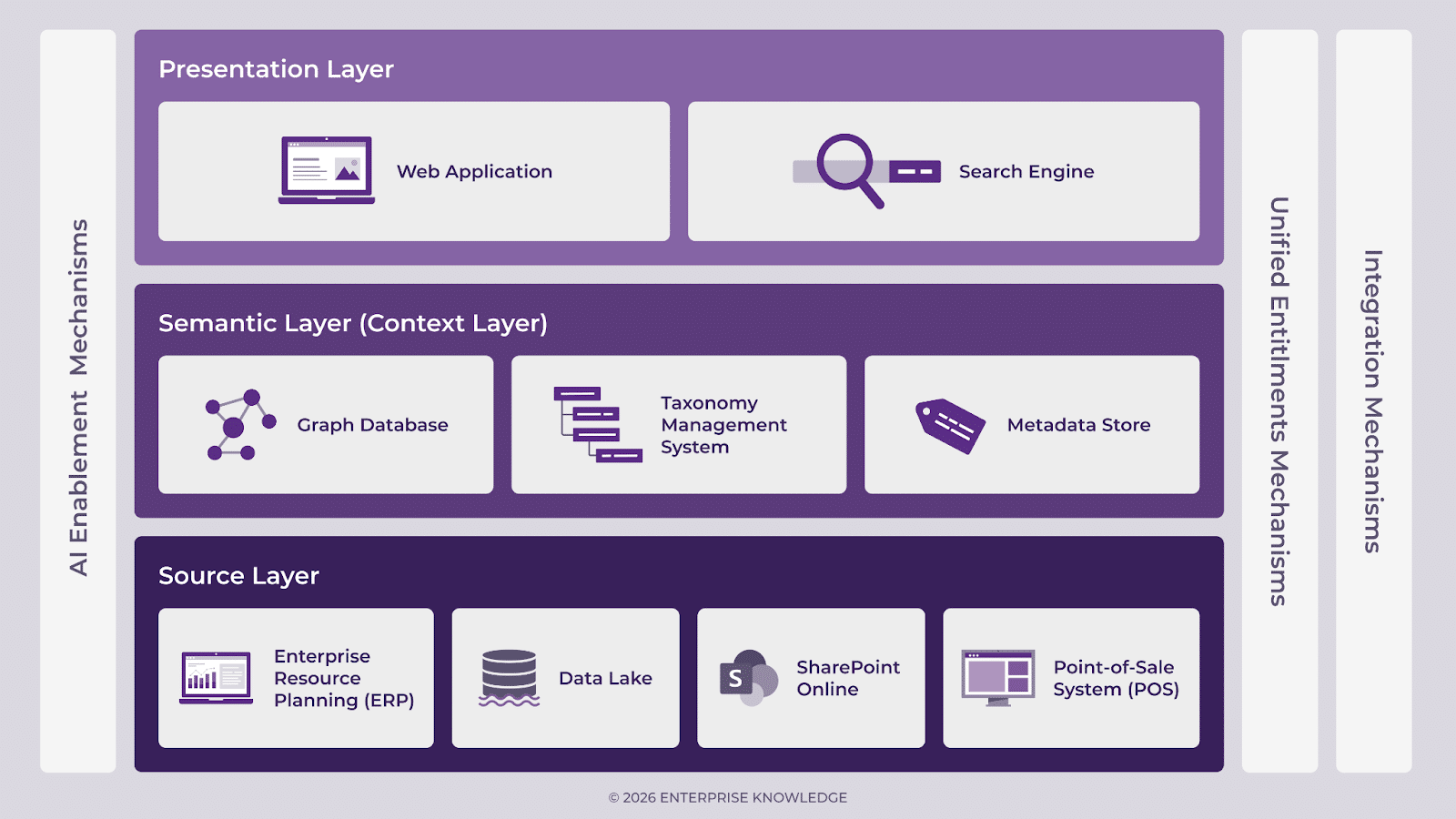
The architecture of an AI Knowledge Portal is very similar to that of a regular graph-based Knowledge Portal. The portal has three primary layers: presentation, semantic, and source. The presentation layer includes a web application for presenting information, along with a search engine to enable both searching and browsing the organization’s entities. The semantic layer is the middle layer that organizes and defines relationships among all organizational assets. It is the context layer for the portal and the LLM. This layer typically includes a graph database to map organizational entities to the data associated with them. It includes a taxonomy management system to categorize both content and data. Finally, there is a metadata store that stores descriptive metadata about the content and data in the organization. The source layer includes tools such as the data lake, the point-of-sale system (if that information is not already captured in the data lake), a product information management system, an Enterprise Resource Planning (ERP) system, SharePoint, and other systems that store information about the organization’s core processes.
In addition to the three layers used to capture and share information through the portal, an AI Knowledge Portal architecture requires three capabilities supporting these layers: integration, LLMs, and Entitlements. An integration capability is needed so that some strategically important data can be loaded into the graph rather than dynamically aggregated on the portal. Given the complexity and volume of the data, this typically requires a data integration platform. LLMs represent another capability used throughout the portal. They interact with the graph to understand context, answering questions or displaying results on the portal. They also help organize data through categorization and information summarization, enhancing the findability of data and documents rendered in the portal. Finally, AI Knowledge Portals need a robust entitlements capability to prevent accidental sharing of confidential information. This is particularly important in a Knowledge Portal because it pulls information from a wide range of applications. Most organizations limit information entitlements by restricting access to systems. This does not work in a Knowledge Portal because it provides access across a wide range of source systems. As a result, security logic (entitlements) needs to be applied to all information before it is exposed through the portal or LLM.
The image below shows the logical architecture of an AI Knowledge Portal.
Conclusion
AI Knowledge Portals are the next step in the evolution of portals and Knowledge Management. These tools break down information silos and provide the information people need to make well-informed, critical business decisions. The days of relying on information from monolithic departmental solutions are coming to an end. Going forward, knowledge workers should expect that information will be organized and accessible in one place, no matter where it originates.
Everyone in the AI space is talking about context. For now, most of that discussion centers on providing context to LLMs to improve the accuracy and reliability of their answers. This is just the first step from our experience. Users need the ability to understand the context of the answers they are receiving. They need to be able to quickly browse deeper into the information related to the LLM’s answers. AI Knowledge Portals provide context for users and LLMs. This modern approach solves the challenges companies currently face with their siloed AI chatbots.
If you are interested in learning more about the AI Knowledge Portals we have already developed or in building one yourself, send us an email at info@enterprise-knowledge.com.