


Beyond the Search Box
Enterprise search is in the middle of a reset. For years, most enterprise search programs were built to return documents and links across repositories, and success was measured by whether employees could locate the right file. That model is no longer enough. The next era of search extends beyond simple question-and-answer queries. It consists of answers paired with context, evidence, and guided discovery, including definitions, constraints, provenance, and clear paths to supporting sources and next steps, enabling users to make decisions with confidence rather than merely retrieving information.
There is a misconception I keep hearing in generative AI conversations: that chat will replace the search box, and the future is simply “ask a question, get an answer.” While AI has facilitated a more robust conversational interface, it overlooks the crucial elements required for search within organizations. Modern enterprise search needs to meet consumer-grade expectations for intent and relevance while also satisfying enterprise requirements like security, traceability, governance, and explainability. Therefore, organizations should move beyond questioning, “How do we integrate AI into search?” and instead ask, “How can I enable holistic search, discovery, and context?”
Knowledge Discovery Maturity Spectrum: How Search Evolves in the Enterprise
Understanding what’s next for enterprise search requires understanding where organizations currently are. EK’s Semantic Maturity Spectrum provides a useful framework for assessing this progression. Advancing along this maturity spectrum does not mean replacing what came before, as each stage adds capabilities that build on the foundation of the previous stages. Enterprise search remains essential even as recommendations, assistants, and agents are introduced because organizations still need a reliable, permission-aware way to locate, filter, and validate source content
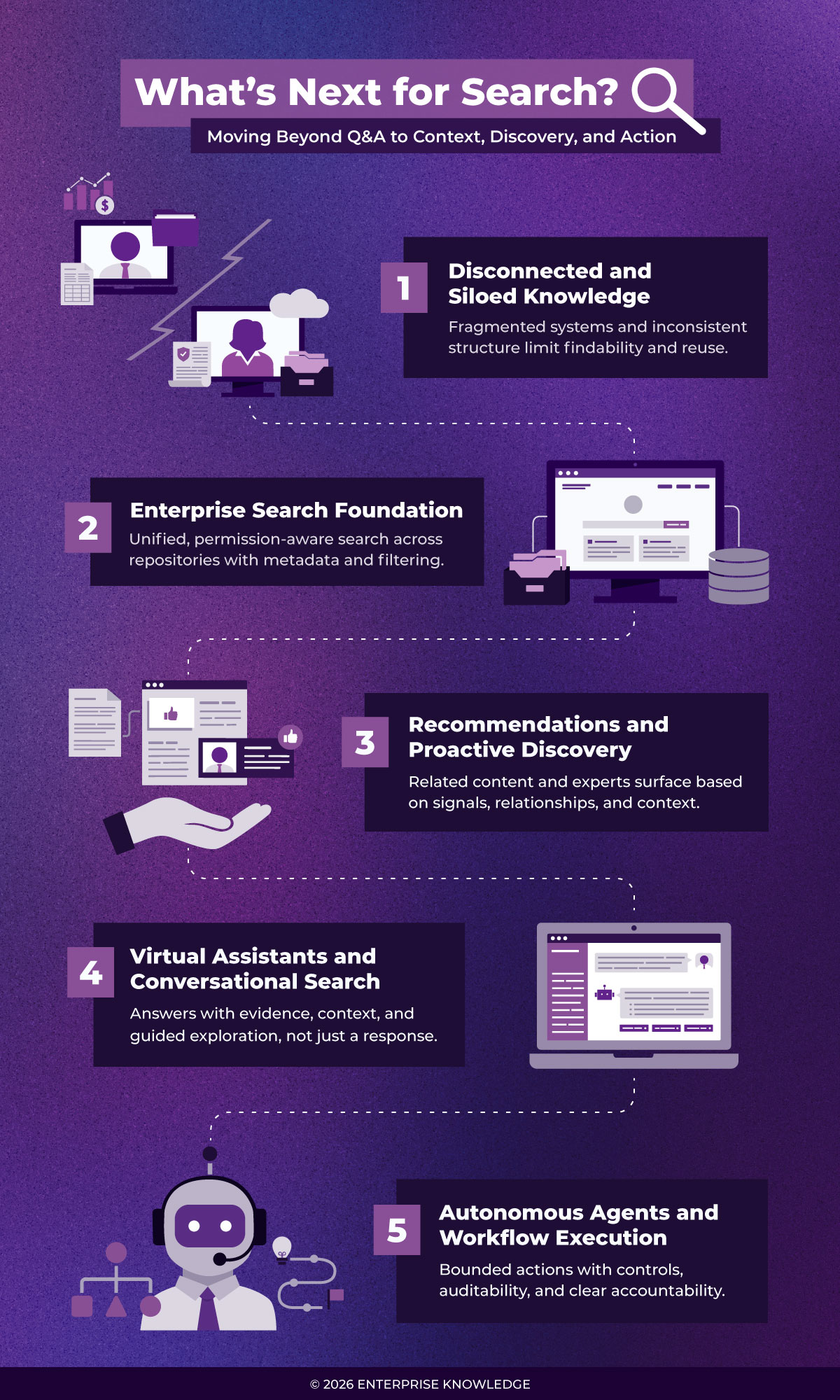
1. Disconnected and Siloed Knowledge:
At the lowest maturity level, teams, systems, and informal networks fragment knowledge. Information exists in email threads, personal drives, and undocumented expertise. Users rely on “who you know” to find what they need, creating friction, duplicate work, and significant knowledge loss when employees leave. This state represents not just a search problem but a foundational knowledge management challenge.
2. Enterprise Search: Unifying access across repositories is the first significant step forward. Enterprise search platforms index content from multiple sources, enabling users to query across systems rather than searching each one individually. However, relevance often plateaus at this stage. Without semantic understanding or richer metadata, search engines return keyword matches that may or may not address user intent. Users learn to work around these limitations by trying multiple queries or reverting to asking colleagues. This is where acronyms, product codenames, policy versions, and regional terminology differences quietly break relevance, even when the right content is technically indexed.
3. Recommendations: A significant shift occurs when organizations move from pull-based searching to proactive delivery of relevant knowledge. Recommendation systems surface related content, similar cases, next-best resources, and relevant experts based on work context. This shift means that reusing knowledge is becoming the norm. EK’s work building a recommendation engine that automatically connects learning content to product data shows that recommendations depend on structured signals: taxonomy tagging, semantic relationships, engagement data, and domain constraints. Practical measures of progress include reduced time-to-answer, increased reuse of validated assets, fewer duplicate artifacts, and fewer escalations to SMEs for routine questions.
4. Virtual Assistants and Chatbots: The interaction model changes fundamentally when users move from scanning result lists to conversational guidance and synthesis. Chat-based interfaces are most valuable when they provide an answer and the supporting context, rather than just a response string. Trust-building experiences prioritize citations, confidence signals, and clarity on when escalation is required.
5. Autonomous Agents: At the highest maturity level, systems move beyond answering questions to completing bounded tasks with clear accountability. Critically, autonomous execution operates within a human-in-the-loop model, where agents handle preparation, synthesis, and execution steps while humans retain oversight for approval, exception handling, and final decision-making. Agentic workflows include drafting briefings with citations, creating structured outputs, routing work items, and updating downstream systems. Agent safety requires permission-aware orchestration, audit trails, and strong constraints on tool use and scope.
Four Key Factors for the New Search Paradigm
As organizations progress along the maturity spectrum, the underlying search architecture must evolve. Hybrid retrieval is becoming the standard pattern because it is the most practical way to capture user intent and balance results coverage with relevance. As I explored in a previous blog on vector search, keywords, semantics, and vectors are complementary approaches, not competing ones. Vector search excels at finding relevant results for natural language and fuzzy intent, but it also brings challenges with explainability, drift, and transparency that must be addressed. Without evaluation and monitoring, relevance quietly degrades over time, and user trust collapses before the issue becomes apparent.
The following four factors provide a framework for maturing search capabilities in alignment with the knowledge discovery spectrum.

1. Designing for Relevance
Search relevance improves dramatically when organizations model the relevant concepts in their domain, such as products, policies, clients, systems, teams, and topics. This is where relevance is enabled because the system can connect what users mean to how knowledge is organized. This process requires understanding how users think about information and what they need to accomplish. Search design best practices emphasize that effective search experiences start with user research and intentional design, not technology selection.
Taxonomies, ontologies, and knowledge graphs increase interpretability and consistency by anchoring searches to business meanings and relationships. EK’s five-step approach to enhancing search with a knowledge graph outlines how organizations can analyze search content, develop an ontology, design the user experience, ingest data, and iterate toward continuous improvement. Knowledge graphs connect entities, enrich results with context, and support exploration paths beyond keyword matches. That same semantic foundation supports both list-based exploration and conversational experiences by keeping meaning consistent across modalities.
Because users express intent differently depending on the task, search needs flexibility across modalities, not a single interface. Faceted navigation and consistent metadata remain foundational to findability, especially in heterogeneous content ecosystems. Traditional results lists remain the most efficient way to compare versions, filter by date or system, and validate sources, while chat adds synthesis and guidance when users need explanations, summaries, or a path forward. The goal is not chat versus lists, but the right experience for the task with traceability and control. Actionable results further reduce time-to-value by enabling users to take the next step directly from the results, such as previewing content, initiating workflows, or connecting with experts, instead of merely opening a file.

2. Providing Proactive Recommendations
Recommendations signal that knowledge is becoming easier to reuse, not just easier to locate. Discovery patterns include related content, similar cases, next-best resources, and relevant experts based on their contributions, affiliations, and demonstrated expertise in the searched topic. This shift from pull-based searching to proactive delivery represents a fundamental change in how organizations surface knowledge.
Recommendation systems depend on structured signals: taxonomy tagging, semantic relationships, engagement data, and domain constraints. EK’s work building a recommendation engine that automatically connects learning content to product data demonstrates how semantic relationships serve as a real-world pattern for bridging silos across systems. Knowledge delivery experiences increasingly blur the line between portals, search, and learning, especially when content must be personalized to user roles and context.

3. Enabling Users with Context
Chat-based interfaces are most valuable when they deliver more than a response string. In enterprise settings, the critical output is an answer paired with the context needed to trust and apply it. Context-rich answers include definitions, scope limitations, rationale, and source evidence, plus guidance on what to look at next.
This is where the “Q&A is the future” misconception breaks down. A system that only answers questions might look impressive at first, but it fails quickly when users need to verify, explain, or operationalize what it provides. Trust-building experiences prioritize citations, confidence signals, and clear escalation behavior. The right pattern is not to always answer, but rather to answer when grounded and show uncertainty or even suggest alternative actions when not.
EK’s semantic search work for an online healthcare information provider illustrates why semantics matter in practice. Medical concepts can be referred to in different ways across audiences and regions, and patients rarely use clinical terminology. A semantic approach that blends enrichment and modern retrieval techniques supports both medical professionals and patients, enabling doctors to search with clinical terminology while allowing patients and caregivers to find the same concepts using everyday language. In other words, assistant success is not only a model problem; it also encompasses architecture, governance, and operations.

4. From Search to Agent Autonomy
In practice, the goal is not open-ended autonomy but bounded execution in well-defined workflows with explicit controls. Autonomous agents move from information delivery to bounded execution. They draft briefings with citations, generate structured outputs, route work items, and update downstream systems. The opportunity is meaningful, but the bar is higher than it is for assistants: once a system can act, it needs enforceable constraints, auditability, and clear accountability.
The practical lesson is that “agent-ready” requires more than a good prompt. It requires permission-aware orchestration, consistent identity and access enforcement, and operating models that define when the system can proceed and when it must hand off to a human. Agents are the natural next step for organizations that already have trustworthy retrieval, grounded assistant behavior, and mature governance.
Practical Path Forward
A practical path forward starts with focus. Identify a small set of high-impact use cases and the knowledge assets that actually drive those outcomes, rather than trying to make all content searchable at once. From there, set a starting point for AI content readiness by checking the quality, structure, duplication, recency, and contextual completeness to ensure accurate retrieval and reliable answers.
Next, tie readiness findings to the operating reality required to scale. Readiness is not only about content cleanup; it is about organizational capability, the state of enterprise data and content, and the change threshold needed to move beyond pilots. Governance and operating models should explicitly address coordination, filling gaps for unanswerable questions, and systematic response to hallucinations so that readiness remains robust over time.
Finally, treat unified entitlements as a first-class dependency for any assistant or agent experience. If permissions are inconsistent across systems, the experience will either leak content or become unusable. Unified entitlements provide a holistic way to apply access rights consistently across asset types and platforms.
With those foundations in place, the maturity sequence stays simple: unify findability, enrich meaning, enable recommendations, introduce assistants with citations and evaluation, and then automate bounded workflows with agents.
Conclusion: The Future of Enterprise Search Is Enterprise Decision Support
The future state is not “Q&A as search,” but decision support that combines answers, context, evidence, and discovery. Search becomes the delivery layer for organizational context, and discovery becomes the mechanism for reuse at scale. Assistants and agents amplify impact only when the knowledge foundation is trustworthy, governed, and measurable.
Enterprise Knowledge helps organizations modernize enterprise search through strategy and roadmap development, semantic modeling and knowledge graph enablement, AI readiness for knowledge assets, and unified entitlements. Whether you are just getting started or moving toward recommendations, assistants, or agents, EK can help you build a foundation that is trustworthy, measurable, secure, and scalable. Contact us to discuss your enterprise search journey and what comes next.