



The semantic layer is a framework of standards and tools designed to work and remain behind the scenes. It is the conceptual layer that sits between your organization’s knowledge assets, like content and data, and the people who need to harness that knowledge for their work. Alternatively, think of it as a universal translator that takes disconnected information from your organization and transforms it into contextualized business insights and understanding. While the inner workings of a semantic layer may be complex depending on specific technical factors, the majority of users will never need to understand the technicalities (those are best left to the roles charged with supporting the ecosystem and keeping it healthy). Most users only need to know how to interact with it to supercharge their tools and knowledge retrieval.
Introducing a semantic layer requires a more comprehensive organizational plan than just the technical implementation; it calls for a deliberate change management approach that tailors change strategies to groups that will be affected. When organizations meet stakeholders where they are and design support around group needs, they turn what could feel like another top-down mandate into something employees genuinely accept. Without this intentionality, organizations risk ineffective interventions: disconnected communications, one-size-fits-all training, and rushed rollouts that cause resistance and confusion. No matter how powerful the technology, poor change management can undermine successful adoption.
EK is a leader in semantic layer maturity assessment and implementation. Through our work with clients, we have learned the importance of socializing a new semantic system in the right way, to the right people, at the right time. This blog explains how a semantic layer adoption strategy requires tailoring your change approach to the diverse roles people will play in the transformation, as well as devising methods to accurately and actionably measure its impact over time.
Common Changes Introduced by a Semantic Layer Transformation
Semantic layer implementations shift an organization’s day-to-day operations in a number of ways. These shifts range from changing how users interact with information (often favoring more self-service access), to requiring additional technical skills to serve in particular roles, to moving from application- and system-centric to data- and knowledge-centric ways of working. At EK, we often see data and knowledge transformation affect change across four categories:
- Structure & Roles: Changes to roles and responsibilities, transfer of roles, and / or major restructuring.
- Business Competencies: Developing existing competencies, and / or adding new ones.
- Processes & Technology: Adjusting processes, systems, and / or business activities.
- Culture: Adopting new concepts, vocabulary, and / or values.
Understanding which of these changes your organization is likely to face matters, but it becomes more meaningful when viewed through the lens of your people.
Stakeholders and Impact: Defining Your Approach to Change
Who is Impacted by the Semantic Layer
Different groups will experience the semantic layer implementation in different ways. Some employees might just need to learn a new way to find information, while others may face changes to their responsibilities, daily workflows, and skill sets. This is where a tailored approach to change begins. By segmenting your stakeholders and understanding how they are uniquely impacted, you can establish relevant measures to track how people are changing and customize the communications and training needed to support them.
Tiered Stakeholder Knowledge Model
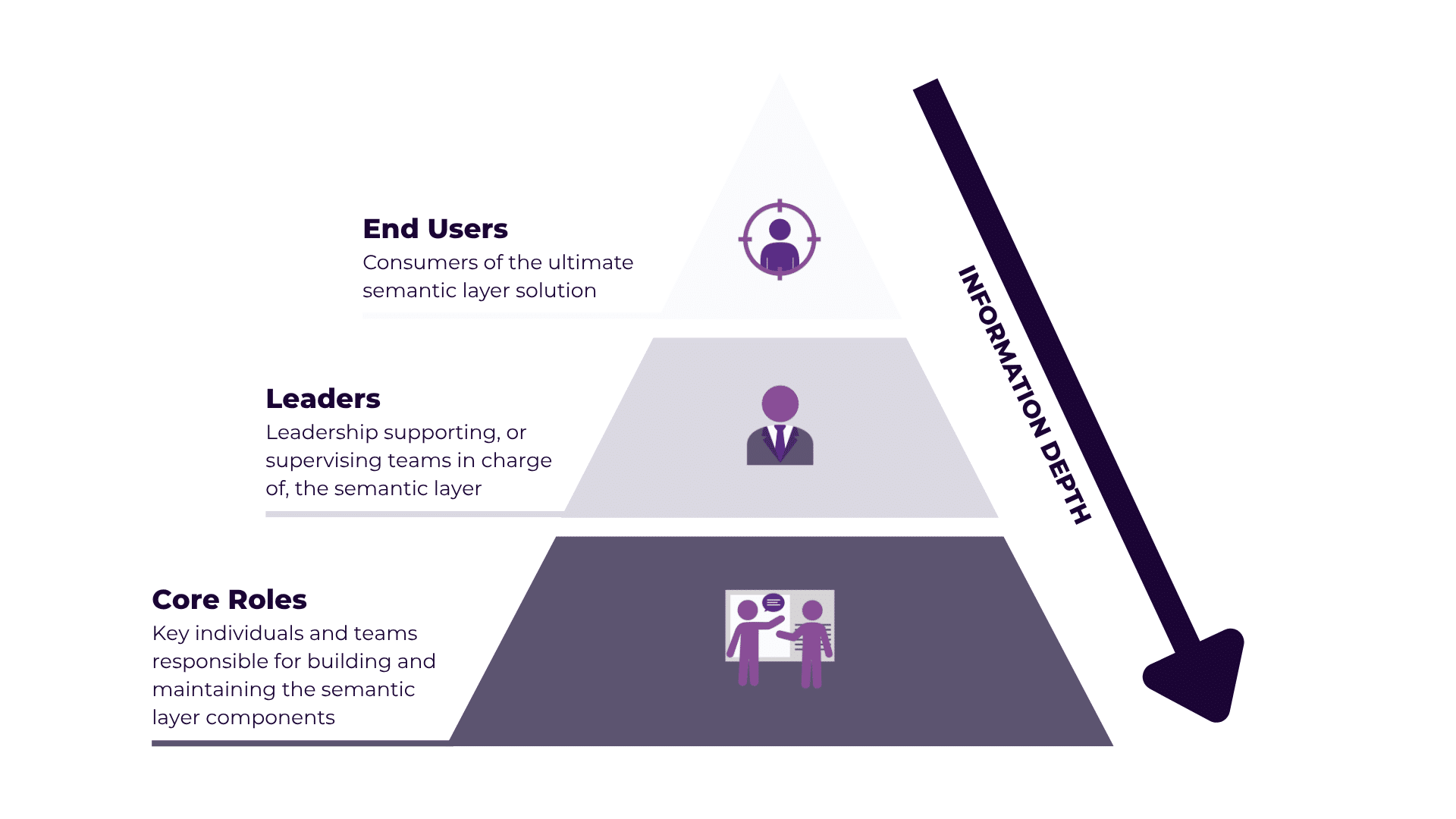
Through the semantic layer implementations that EK has led, three different stakeholder groups tend to emerge at a high level when assessing change impact: end users of systems (for example, knowledge portals, dashboards, chatbots, etc.) supported by a semantic layer, the leaders most responsible for ushering in the system adoption, and the core roles responsible for maintaining major elements of the transformation. The types and degrees of changes felt by these broad groups hold across most organizations, so much so that it has inspired a tiered stakeholder knowledge framework we employ in semantic layer projects. The degree of change these groups experience informs the information depth they need. Your end users, who will likely experience the least amount of change comparatively, should receive essential and practical knowledge about the initiative in communications and training. As the degree of expected change increases (as we move down the pyramid to other groups), so too should the complexity of information embedded in their targeted change efforts.
Group Identification and Impact Assessment
Working with the semantic layer project team members and project sponsors to identify impacted groups is an ideal way to inventory the stakeholders directly and indirectly relevant to a semantic layer implementation. There is no single right way to define and segment your groups. You might start by considering organizational structure (divisions, departments), role type (managers, individual contributors), how people will interact with the system (end users, system maintainers), or the categorization utilized in the tiered stakeholder framework (end users, leaders, core roles). During this activity, experiment to find the groupings that are specific enough to inform distinct change strategies, but broad enough to remain practical. Then inventory the types of changes and the anticipated degree of change they will experience for each type.
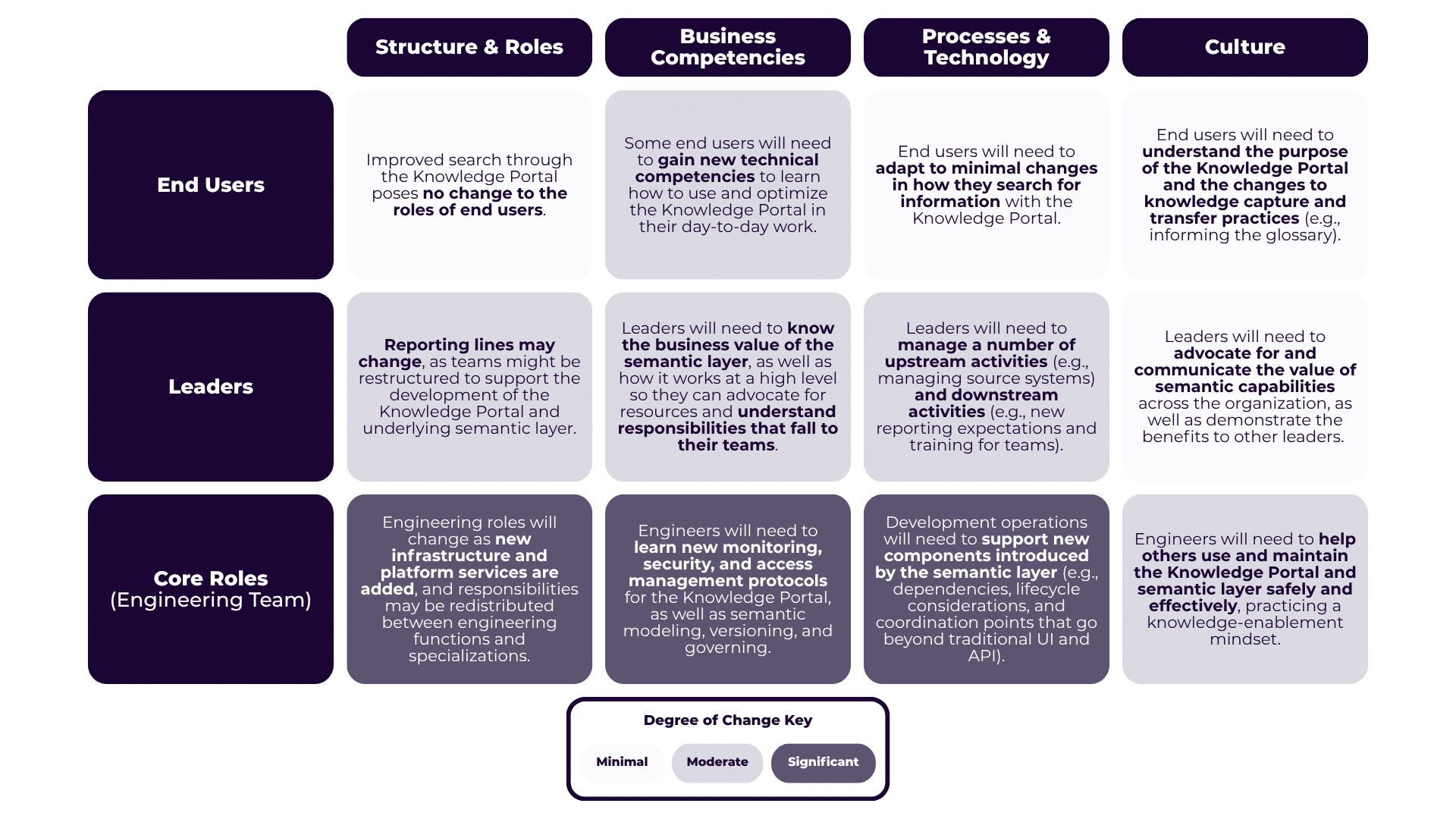
To help identify what is changing and how much is changing for each group, consider the following approach. Categorize the type of change by how it manifests within the organization, using the four change categories introduced above: structures and roles, business competencies, processes and technology, and the culture of the organization. In addition to detailing what change will look like for the groups, rate the degree of change each group will need to adapt to across each change category using a 3-level scale: minimal, moderate, or significant. To see one example in action, the following table illustrates anticipated types and degrees of change for an organization implementing a semantic layer as the framework for a knowledge portal. Stakeholders are segmented into end users, leaders, and an engineering team (representing the core roles group from the tiered stakeholder framework).
Once you identify impacted groups and anticipate the magnitude of their expected change, the next step is defining what a successful transition looks like for them.
Defining Success and Measuring Impact
Before designing specific communications and training to usher groups through the change, it is critical to define clear methods and targets that evaluate both the technical performance of your semantic layer and the behavioral shifts of your people. Do this by establishing change outcomes (desired business results or goals for the semantic layer solution) and defining related success indicators (observable evidence that the outcome is being achieved). These metrics provide the necessary structure and guardrails to track progress toward an effective implementation over the short- and long-term. Measuring the technical solution (e.g., system usage, search retrieval speeds) and how people are changing (e.g., leadership advocacy, acquisition of new technical skills, cultural shifts toward knowledge sharing) requires a dedicated change manager or group to collaborate with the technical leads to align with the system’s capabilities and expectations. While we have previously outlined KPIs for tracking the technical success of a semantic layer implementation, here we focus on the metrics for measuring behavior and people change.
An organization should establish current state baseline metrics for each change outcome before formally defining their targets, accounting for available resourcing, budgeting, and time or staffing constraints. Regular refinement and validation of the targets by accountable groups will help to monitor for consistency and relevance as operations evolve. Additionally, we recommend creating repeatable processes for tracking success indicators where possible. Stand up and manage mechanisms (e.g., surveys, self-reporting logs, or release notes) at a cadence that makes sense for how your organization operates.
Targeted Communications and Training
After change outcomes and success indicators are developed, specific change activities can be identified that aim to help stakeholders meet those outcomes. Communications and training are primary ways in which information is used in change management efforts, but applying the same communications or training strategy to all stakeholder groups can have detrimental effects. For example, providing too much technical detail about what elements power the semantic layer creates noise for an average user and risks their immediate dismissal of it. However, that level of depth is necessary for the core technical roles maintaining it. Employing the tiered stakeholder model, a few rules emerge about the depth of information transferred during change efforts:
- Communications and training for end users should focus on what’s changing for them, how they will benefit in their day-to-day work, the key steps they need to take to access it, and how their feedback will be solicited to expand and evolve the work of the solution.
- Leaders need to know the business value the system brings, as well as how the technology works at a high level so they can advocate for resources and understand responsibilities and the accountability that falls to their teams.
- Technical details should be reserved for the core roles responsible for maintaining the health of the solution. They should know about the technical value and the business value the organization seeks from it and what they need to do to sustain both.
Putting It All Together
Mapping outcomes and indicators to tailored change activities helps stakeholders see how everything connects. At EK, we use a framework like the example below to catalog key details, including:
- Outcome: The desired business result or semantic layer solution goal.
- Indicator: The observable evidence that the outcome is being achieved.
- Source: Where and how to gather the evidence.
- Responsibility: Who is accountable for collecting the evidence.
- Frequency: How often to gather the evidence.
- Target: A recommended goal for each success indicator.
- Change Activity: Tailored intervention(s) to drive behavior.
| Outcome | Indicator | Source | Responsibility | Frequency | Target | Change Activity |
| Enhanced content findability and discoverability, improving end user satisfaction. | Amount of time people report spending looking for information | Staff Survey | Core Roles Assigned to Taxonomy And / Or Ontology | Quarterly | e.g. 75% of survey participants report spending less than 20 minutes to find the right information to do their work | Develop a curated list of commonly asked search and navigation FAQs to help End Users adapt quickly. |
| Average user satisfaction rating regarding the new search and discovery experience | Staff Survey | Core Roles Assigned to Taxonomy And / Or Ontology | Quarterly | e.g., 85% of survey participants rate the new search experience as “Satisfactory” or “Highly Satisfactory” | Host interactive feedback sessions where End Users can see how their input is being used to evolve the solution. | |
| Active leadership advocacy for the semantic layer and communication of its business value across the organization. | Number of presentations or discussions on the semantic layer led by management during team or all-hands meetings | Self-Reported Data (e.g., via a change management tracker or internal form) | Change Management Lead or Group | Quarterly | e.g., 80% of identified leaders have presented the semantic layer vision to their direct reports within the first 6 months | Provide pre-packaged talking points, slide decks, and strategic value statements so Leaders are fully prepared to advocate during team meetings. |
| Adoption of a “knowledge- enablement” mindset by core roles (engineers), actively maturing the semantic layer based on end user needs. | Number or percentage of feature requests and system updates rolled out that were directly suggested by users | Release Notes, Development Tracker (e.g., Jira), or Help Desk Logs | Engineering Lead or Product Owner | Quarterly | e.g., 30% of quarterly releases include enhancements directly tied to end-user feedback | Publish the development roadmap internally to promote transparency, and share success stories showcasing how the engineering team’s updates directly improved the end-user experience. |
This exercise will empower your organization to define relevant change activities needed to meet business outcomes, drive adoption, and measure success.
Closing
By understanding the kinds of changes a semantic layer solution can introduce into your stakeholders’ day-to-day routines, how they impact different groups, and how to iteratively tailor your approach to each one, you can build a change management approach that socializes the semantic layer and its capabilities in the right way, to the right people, at the right time. If your organization is about to embark on a similar change effort, or if you’re currently undergoing one, Enterprise Knowledge can support you. Contact us at info@enterprise-knowledge.com to discuss how we can help bring your semantic layer solution to life. In the second blog in this series, we will walk through practical steps to plan and facilitate a semantic layer change effort in an organization, drawing on real examples from our clients.